
On this page
How seamless gutters are made
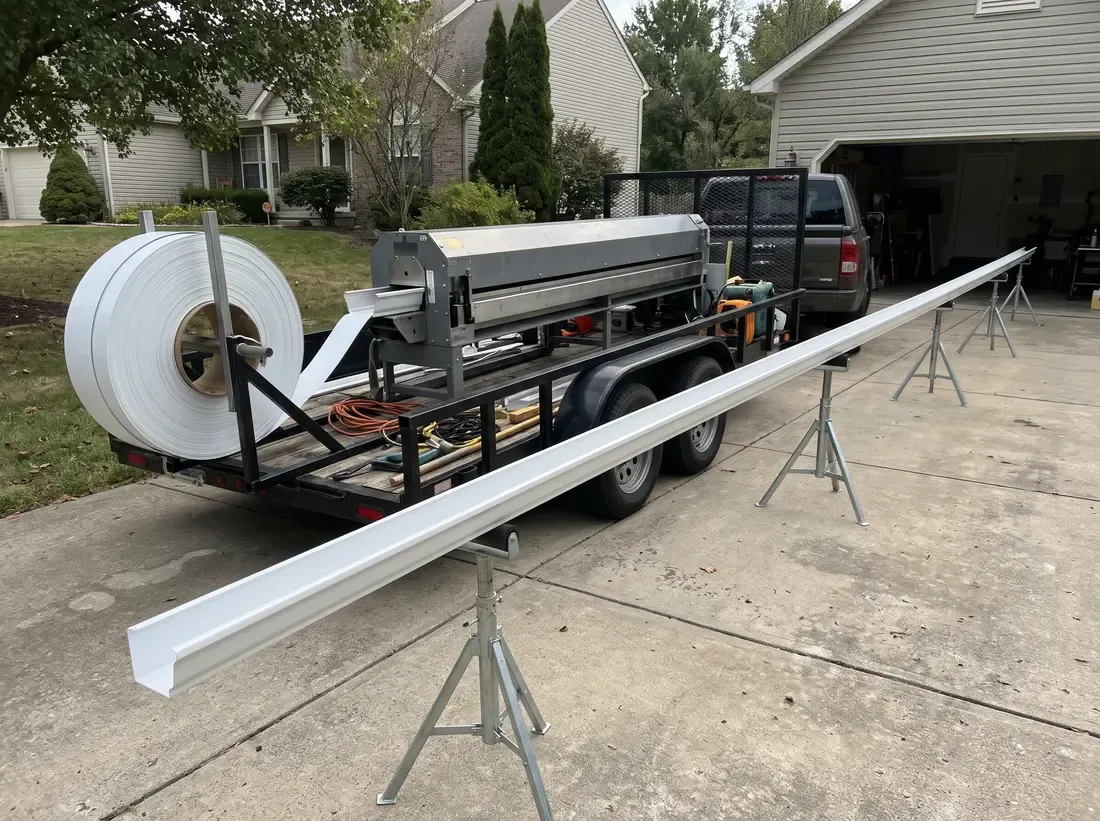
The contractor brings a gutter machine on a truck or trailer. Flat aluminum coil feeds in one end, and rollers bend it into a K-style or half-round profile. The crew measures each eave, runs out a piece to that length, and carries it up. The only joints are where two runs meet at a corner, at the end caps, and where outlets are cut for the downspouts.
Why fewer joints matter in Kirkland
Sectional gutters come in 10-foot lengths joined with connectors and sealant. On a 180-foot house that is well over a dozen extra joints. In most climates a joint gets wet, then dries. Here, gutters can stay wet from the first fall storms to spring; Sea-Tac sees measurable rain on about 150 days a year. A joint that starts to weep in October drips onto the fascia all winter. Over a few seasons that is how fascia boards rot from the back.
Seamless gutters do not end that risk, but they remove most of the places where it starts.
What to specify
| Item | Good practice | Why |
|---|---|---|
| Profile | 5-inch or 6-inch K-style; half-round on older houses | K-style carries more water for its width |
| Coil thickness | .027 inch minimum, .032 on long or high runs | Thicker coil resists dents from ladders and limbs |
| Hangers | Screwed hidden hangers | Hold a wet load of needles; spikes work loose |
| Pitch | About 1/4 inch per 10 feet | Keeps water moving so debris does not settle |
| Corners | Mitered, riveted, sealed in dry weather | The main leak points |
| Downspouts | 2x3 or 3x4, strapped at every joint | 3x4 clogs less with needles |
Seamless on Kirkland houses
Ramblers and split-levels in Rose Hill, Kingsgate, Juanita and Finn Hill usually take 5-inch K-style. Two-story houses in Houghton, Bridle Trails and the newer rebuilds often have big roof planes and valleys that suit 6-inch. Bungalows in Norkirk and the Highlands may look better in seamless half-round; see half-round gutters.
Common mistakes to avoid
- Choosing the thinnest coil to save money, then watching it dent under a falling branch.
- Accepting spikes or widely spaced hangers on a house under big conifers.
- Letting the crew seal corners on a wet day; sealant needs dry metal to bond.
- Forgetting the drip edge, so water still runs behind the new gutter.
- Connecting new downspouts to an old tightline without testing it.
Seamless or sectional?
Sectional gutters from a store are cheaper and can be put up by a handy owner on a shed or garage. On a house in this climate, seamless is almost always the better buy. See seamless vs sectional.
In Kirkland and the Eastside
Seamless is now the norm on most Eastside houses, from the 1960s split-levels in Kingsgate and Juanita to the new two-story rebuilds in Houghton, Rose Hill and West Bellevue. The houses still on sectional gutters are usually older ramblers that were never upgraded, garages, and some do-it-yourself additions. Under the region's tall conifers, a straight seamless run on close hangers is also the best base for a micro-mesh guard.
When to do it
The dry season from May to September is the best window. Metal is dry for sealing corners, ladders sit on firm ground and crews are not tied up with storm calls. Book in spring; by August many contractors are booked several weeks out.
What to ask before you agree
Ask for the coil thickness and hanger spacing in writing, how many downspouts are included and at what size, whether drip edge and fascia repair are priced, and whether the tightlines will be hose-tested before reconnecting.
How a seamless installation runs
- The contractor measures each eave, counts corners and outlets, and checks the fascia and drip edge.
- You get a written quote listing gutter size, coil thickness, color, hanger type and spacing, downspout size and number, and any fascia work.
- On the day, old gutters come down and soft fascia is replaced.
- The machine forms each run to length on site.
- Runs are hung on screwed hidden hangers at the agreed pitch, corners are mitered, riveted and sealed, and outlets are cut.
- Downspouts are strapped, connected to tightlines or splash blocks, and every run is water-tested.
- Old material is hauled away, and you get the warranty in writing.
Seamless and the Eastside's trees
Under Douglas firs and cedars, a seamless system's weak points are the outlets and the hangers rather than the joints. Ask for 3x4 downspouts on the busiest runs, hangers at about 2-foot spacing under trees, and a guard where needles are heavy. Seamless gutters are also the best base for a micro-mesh guard, because a straight, well-pitched run with few joints holds a guard flat and drains under it evenly.