
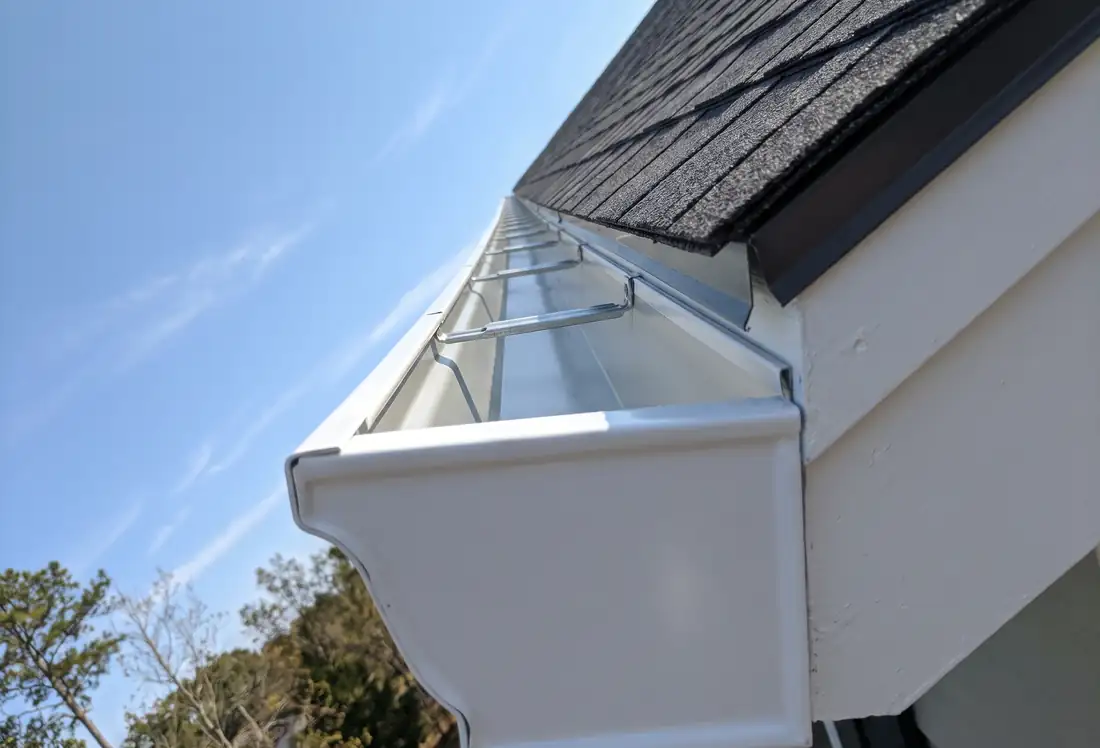
What causes a sag
| Cause | Sign | Fix |
|---|---|---|
| Spikes working loose | Spike heads backed out of the gutter face | Replace with screwed hidden hangers |
| Hangers too far apart | Droop between each hanger | Add hangers at closer spacing |
| Soft fascia | Screws spin; wood crumbles when probed | Replace the board, then rehang |
| Wet debris load | Sag where needles and moss collect | Clean, rehang, consider guards |
| Limb strike | Run bent at one point | Replace the length if kinked |
| Ladder damage | Dent and kink at one spot | Replace the length |
The weight of wet debris
Dry leaves weigh little. Wet fir needles, cedar scale, moss and shingle grit, packed in a trough and soaked by weeks of rain, weigh a lot. Gutters hung on spikes every 3 or 4 feet start to droop in the middle of long runs, usually under the biggest trees. Once a sag starts, it holds more water and debris, and it gets worse.
When a run is rehung, the contractor should:
- use screwed hidden hangers that tie the front lip to the back,
- space them closer under trees,
- set the back of the gutter under the drip edge,
- re-pitch about a quarter inch per 10 feet so the trough drains between storms.
Fascia first
A hanger is only as good as the wood behind it. In a climate this wet, fascia behind a leaking or overflowing gutter often rots along the bottom edge. Any soft wood is cut out and replaced before the gutter goes back up. See fascia and soffit.
Common mistakes to avoid
- Driving spikes back in rather than switching to screwed hidden hangers.
- Rehanging on soft fascia.
- Forgetting to re-pitch, so the run still holds water.
- Leaving the debris that caused the sag in place.
In Kirkland and the Eastside
Sags are common on 1990s and 2000s builder-grade gutters in Redmond, Sammamish and Bothell, and on older spike-hung gutters in Kingsgate, Rose Hill and the Highlands, especially under big trees.
When to do it
Any dry day. Rehanging is quick, and a well-pitched run drains better through the wet season.
What to ask before you agree
Ask what hangers will replace spikes, the new spacing, and whether the fascia will be checked.
Why rehanging beats patching
Pushing a sagging gutter back up and driving the spike in again lasts a season at most. The spike has already enlarged its hole in the wood, and the next wet load pulls it out again. A proper repair replaces spikes with screwed hidden hangers, adds hangers where spacing was too wide, and sets the pitch so the run drains fully between storms.
Where sags start
Sags usually start in the middle of long runs, under the biggest trees, and on runs below valleys where debris collects. If one section sags, check the whole house; the same hangers were used everywhere.
Related
See leaking gutters, gutter guards and fir needles, moss and gutters.