
On this page
When 5-inch is not enough
| Factor | Why it matters |
|---|---|
| Large roof planes | More area draining to one gutter |
| Steep pitch | Water moves faster and can overshoot a small gutter |
| Valleys | Two roof planes pour into one spot |
| Few downspouts | Each outlet drains a longer run |
| Long rains | November averages over 6 inches at Sea-Tac |
| Atmospheric rivers | Days of heavy rain, like fall 2021 |
The rebuild effect
Across Kirkland, smaller houses from the 1950s to the 1970s are being replaced with large two-story homes. The new roofs are bigger and steeper, with more valleys, and builders often fit standard 5-inch gutters and 2x3 downspouts anyway. In the first big rain, water pours off the valleys. Upsizing the worst runs fixes it.
6-inch or more downspouts?
Adding a downspout halves the length each outlet drains, which can be enough on a single-story house. On a two-story house with a steep roof, the gutter itself may be overflowing at the valley before the water reaches an outlet. Then the bigger gutter is the fix.
Downspouts that go with 6-inch
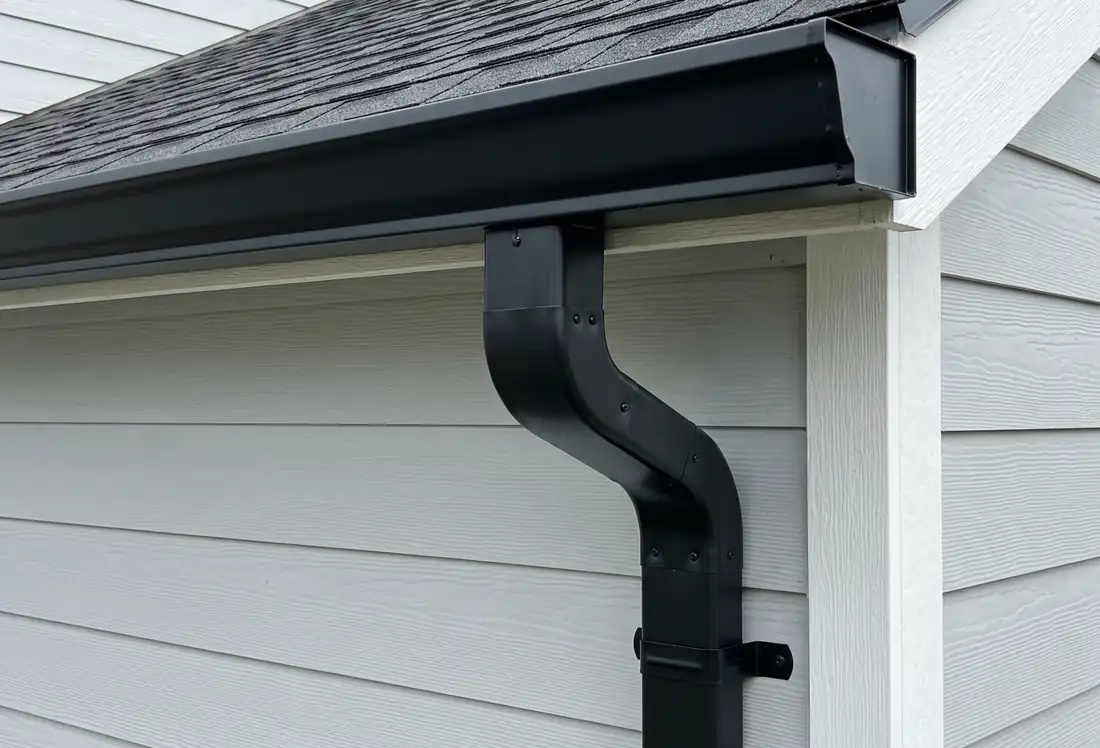
A 6-inch gutter is usually paired with 3x4 downspouts. The bigger pipe carries roughly twice the water of a 2x3 and lets needles and cone scales pass more easily. Where a downspout connects to a buried tightline, check that the tightline itself is big enough and clear.
Common mistakes to avoid
- Going up to 6-inch but keeping 2x3 downspouts, which then become the bottleneck.
- Fitting 6-inch to cure an overflow that is really a blocked outlet or a sag.
- Joining 6-inch and 5-inch at a corner without a proper transition, which leaks.
- Connecting larger downspouts to a cracked or undersized tightline.
In Kirkland and the Eastside
The houses that most often need 6-inch gutters are the large two-story rebuilds that have replaced smaller homes across Houghton, Lakeview, Rose Hill, Everest, Norkirk and West Bellevue, and the big custom homes in Clyde Hill, Medina and the Points. Older ramblers and split-levels in Kingsgate, Juanita and Rose Hill rarely need them.
When to do it
Watch your gutters in the first long rain of the season. If they overflow when clean, book the change for the following dry season.
What to ask before you agree
Ask which runs need 6-inch and which do not, what size downspouts come with them, and whether any existing tightlines can carry the extra flow.
How a contractor decides
A good contractor looks at each run, not just the house. The questions are how much roof drains to that run, how steep it is, whether a valley empties onto it, and how many outlets it has. Often only two or three runs on a house need 6-inch, usually below valleys on the main roof, while porch and garage runs stay 5-inch.
Testing before you buy
If you are not sure, watch the gutters in a heavy rain with them freshly cleaned. Water pouring over the front of a clean gutter, especially at a corner below a valley, points to capacity. Water spilling only at one low spot points to pitch or a sag. Water bubbling at the bottom of a downspout points to a blocked tightline.
Related
See 5-inch vs 6-inch gutters, downspouts and seamless gutters.